

Superdates - Key Themes and Highlights - November 2026
November 2026 brings a fascinating combination of heightened awareness, transformation and opportunity. Explore the month's Scorpio New Moon intention period, Gemini Full Moon release period and the intriguing symbolism of Friday the 13th, as astrology and Chaldean numerology reveal how we might work more consciously with time.

Numerology 10–19: The Decade of Emergence
An introduction to compound numbers and the first compound decade, 10–19. Explore why the root number is only part of the story, how compound numbers develop their own distinct expressions, and how numbers sharing the same root form larger developmental sequences.

Libra - What Happens When We Meet the Other?
Libra asks what happens when the developing self encounters someone who is genuinely other. Through relationship, polarity, and the Ascendant–Descendant axis, we discover how difference can challenge, reveal, and expand who we are becoming.

When Symbols Start Answering Back
A look at synchronicity, symbols, and the strange question of what comes first. Do symbolic systems simply reflect what is already unfolding, or does engaging with them somehow change what happens next? An exploration of numerology, tarot, guidance, and what happens when the symbols seem to start answering back.
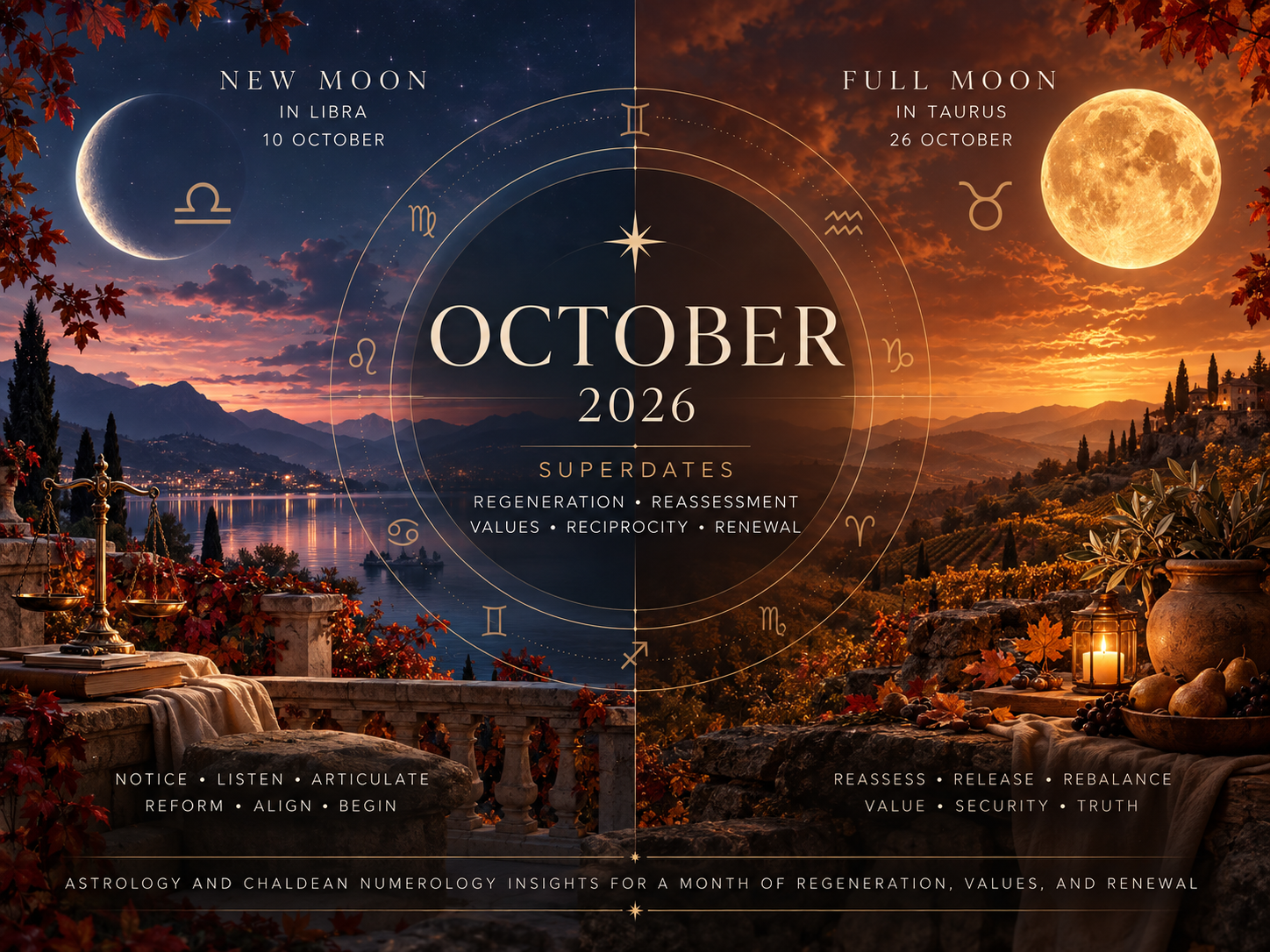
Superdates - Key Themes and Highlights - October 2026
October 2026 opens a new cycle, but with Venus and Mercury retrograde, the path forward is shaped by reassessment as much as initiation. Explore the Libra New Moon and Taurus Full Moon timing windows through astrology and Chaldean numerology.

The Human Search for Meaning Through Symbolic Systems – From Astrology to Symbolic Intelligence
Why have human beings created so many symbolic systems, and why do they so often return to the same questions of identity, timing, purpose, relationship and change? In this revised and extended essay, I explore my own journey through astrology, numerology and symbolic intelligence, and why I have become increasingly interested not only in individual systems, but in the patterns that emerge between them.

Spiritual Awakening Needs a Container
Spiritual awakening is often described in terms of expansion, activation and opening, but far less is said about containment. When familiar ways of understanding reality begin to loosen, the experience can be as disorientating as it is transformative. This article explores the importance of grounding, discernment, and safe spaces, and considers how symbolic intelligence can help us engage meaning without losing our footing.

Are You a Cat, a Dog — or Slightly Feral?
Are you more cat-like or dog-like in the way you relate? This playful framework explores independence, closeness, compatibility, wounded patterns, and what happens when we stop trying to become another “species” in order to belong.

When Everything Becomes Too Interesting - A Virgo Lesson in Discernment
When you are naturally drawn to patterns, meaning and what lies beneath the surface, almost anything can become interesting. During Virgo season, I have been considering the other side of this capacity - knowing when not to analyse, interpret or improve, rediscovering the value of ordinary people and experiences, and exploring how greater discernment may also help us move from service towards Sacred Service.

Superdates - Key Themes and Highlights - September 2026
September brings a powerful interplay between completion and new direction. Explore two of the month’s key Superdates periods, combining astrology and Chaldean numerology to work consciously with the Virgo New Moon, the Aries Full Moon, intention, release and right relationship.

Behind the Scenes - How I Use Symbolic Intelligence
Symbolic systems can offer far more than interpretation. In this behind-the-scenes exploration, I share how I use astrology and numerology within my own life and the development of Astrrid.com — from personal growth, name change and longer-term cycles to Superdates, business decisions, and everyday planning. It is an evolving approach to working with symbolic information consciously, whilst retaining judgement, choice and personal agency.

The Human Search for Meaning Through Symbolic Systems
Throughout history, human beings have sought ways to understand themselves and the world around them. Across cultures and civilisations, symbolic systems such as astrology, numerology, mythology and the I Ching have emerged as different ways of exploring identity, relationships, timing and meaning. Rather than examining these traditions in isolation, this article explores what they have in common, why symbolic systems have appeared so consistently throughout history, and how they continue to shape the ways we make sense of human experience.

The Architecture of Numbers 0-9 in Chaldean Numerology
The numbers 0–9 are often taught as individual meanings, but they can also be understood as a developmental sequence. From potential and emergence through growth, structure, adaptation, harmony, manifestation, and completion, each number builds upon the one before it. This article explores the underlying architecture of numbers in Chaldean Numerology, and the symbolic process through which reality unfolds.

Beyond The Articles - Inside The Astrrid Journal
What if a newsletter could be more than a mailing list?
The Astrrid Journal is an evolving body of work exploring astrology, numerology, naming, timing, personal development, and the patterns that shape meaningful change. Alongside new articles, subscribers receive monthly Superdates, behind-the-scenes insights, research notes, and updates on future resources, services, and projects. It is a place to follow ideas as they develop, connect seemingly separate subjects, and explore the deeper cycles that influence both our lives and our work.

Naming & Becoming (Part 2) - A Name Change Is Not Always Reinvention
Many people assume that changing a name is an attempt to become someone else. Yet not every name change is driven by dissatisfaction, reinvention, or a desire to escape the past. In this second article of the Naming & Becoming series, I explore the difference between reinvention and alignment, the role that names play within Chaldean numerology, and why some identity changes emerge not from rejection, but from a sense of completion.

Superdates - Working With Time Rather Than Against It
Timing plays a larger role in our lives than many people realise. In this article, I explore the concept of Superdates—days where supportive astrological and numerological influences align—and how understanding timing can help us make more conscious decisions. Discover how I identify Superdates, how I use them in my own life and business, and why working with the prevailing conditions can sometimes make all the difference.

Can Support and Freedom Coexist?
Can support and freedom coexist, or must we choose between them? Drawing upon astrology, numerology, business building, relationships, and personal experience, this article explores a question that has followed me through many areas of life. What if self-reliance is not the final destination, but simply one stage in a larger journey towards creating structures, relationships, and forms of support that allow freedom to flourish?

Naming & Becoming (Part 1) - When Your Name No Longer Fits
Why do human beings place so much importance on names? From marriage and family traditions to stage names, spiritual initiations, and business identities, names seem to carry far more significance than simple labels. In this first article of the Naming & Becoming series, I explore the connection between names, identity, and transformation, and ask what it might mean when a name no longer feels like it fits.

The Relationship Question Hidden in Your Chart
What if your birth chart is not simply describing who you are, but revealing the questions you are here to explore? By examining the relationship between the Moon and Venus, we can uncover the deeper themes that shape our experiences of connection, intimacy, trust, and partnership throughout life.

Beyond Sun, Moon, and Rising - The Architecture of a Birth Chart
When I received my first full natal chart in my early twenties, I expected clarity. Instead, I found myself confronted with a series of separate descriptions that never quite fitted together. Over time, this led me to a different question - rather than asking what each placement means in isolation, how does the chart function as a whole? This article explores the planets, angles, chart ruler, and the unfolding nature of the birth chart - examining how astrology may reveal not just personality, but a deeper process of integration, development, and becoming.