
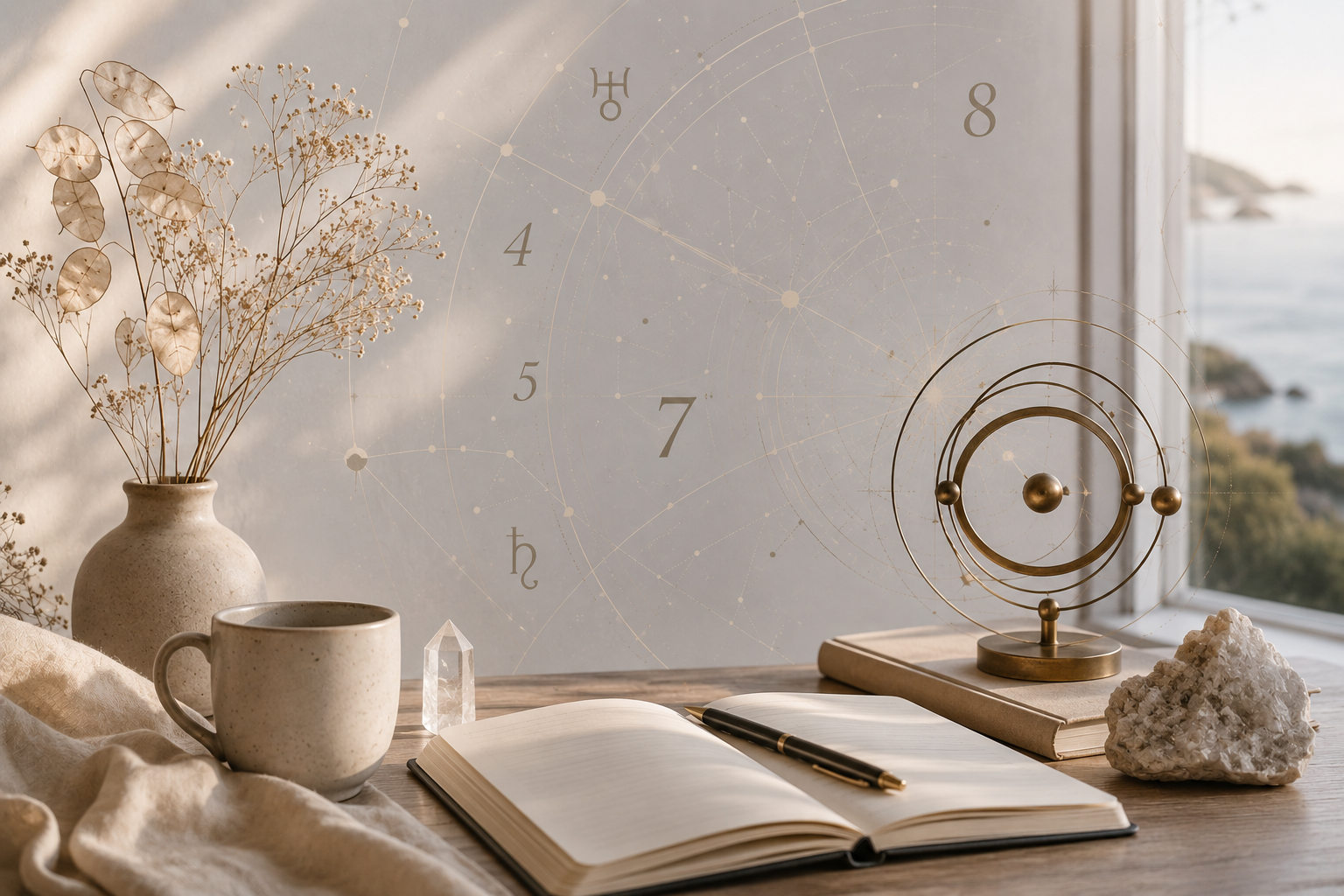
Serene desk with cosmic details by Astrrid and AI
5th May 2026
I have noticed something about myself over the years that initially appeared contradictory.
I have a busy mind. I tend to work in fluid, adaptive, and sometimes chaotic ways. I struggle with rigid routines. I often need space for ideas, associative thinking, changing focus, and creative movement. Too much structure quickly becomes psychologically claustrophobic for me, and energetically exhausting.
And yet at the same time, I have realised that I function best within relatively stable environments.
Not rigid or controlled environments, but emotionally and structurally predictable ones. And this need seems to have grown as I have gotten older.
A settled home environment matters to me enormously. Indeed it is critical to my health and wellbeing. The people closest to me tend to be psychologically steady individuals. Not necessarily calm all the time — life does not work like that — but fundamentally coherent and relatively predictable in how they move through the world.
As I contemplated this more deeply, I noticed that the same pattern has existed within friendships and relationships throughout my life. I have been naturally somewhat changeable in nature — moving through different interests, environments, phases, and periods of life — so it has always felt normal that some people would naturally come and go over time. But separately from this, there have also been friendships and relationships that I consciously chose to step away from because the level of emotional volatility eventually became too energetically draining to sustain. The same has been true romantically. The relationships that endured were rarely the most dramatic or emotionally intense, but the ones where there was enough steadiness for trust, rhythm, and continuity to emerge. Again, this seems to only grow in importance as I get older and I increasingly recognise the value in sometimes resisting my own need for change, and instead replacing this with greater stability in my own life to accommodate this need.
But what this has led me to consider is that this seems to directly contradict how people often think about adaptability.
There is a cultural assumption that highly adaptive people should naturally thrive within unstable environments. That flexibility means being able to tolerate constant unpredictability, inconsistency, emotional turbulence, or social chaos.
But I no longer think these things are the same. In fact, I suspect the opposite may often be true.
Some of the most internally dynamic people require the greatest degree of environmental coherence in order to function sustainably.
Internal Dynamism and External Stability
I increasingly think there is an important distinction between internal variability and external variability.
Some people are internally steady and externally adventurous. They are psychologically anchored enough to tolerate highly unpredictable environments without becoming depleted. Others are internally dynamic. Their minds are already highly active, adaptive, associative, perceptive, nonlinear, or energetically responsive. Their inner world contains substantial movement already.
For these individuals, excessive instability in the immediate environment can become exhausting surprisingly quickly. Not because they are weak, are incapable, or because they “cannot cope”. But because unpredictability consumes energy.
Highly adaptive internal systems are often already processing :-
multiple perspectives
symbolic associations
emotional undercurrents
future possibilities
changing patterns
social atmospheres
conceptual movement
Often all at once - and I can personally vouch for how energetically hungry this can be!
When the external environment also becomes emotionally chaotic, inconsistent, or unstable, the nervous system may never fully settle enough to recover. The result is not necessarily collapse – often it simply becomes chronic expenditure.
Stability Is Not The Same As Rigidity
One of the misconceptions around stability is that people immediately associate it with :-
conformity
repetitive routine
lack of spontaneity
over-structuring
boredom
But that is not actually what I am describing. I do not personally thrive within highly rigid systems. Too much fixed routine can become draining in a different way. I need flexibility. I need movement. I need intellectual and creative openness.
What I seem to need is stable architecture combined with flexible participation.
This is one of the reasons the Power of Eight groups — developed through the work of Lynne McTaggart — have been so interesting for me to observe psychologically. I have been part of a Power of Eight group since January. The group itself functions seven days a week. There are core members who attend daily. I have repeatedly noticed that I cannot personally sustain that level of continuous participation. It is not any lack of commitment – indeed I am truly committed to the group. But trying to conform to the full structure literally exhausts me.
And yet the existence of the structure itself feels stabilising.
Knowing the group exists. Knowing there is continuity. Knowing there is rhythm. Knowing there are familiar people holding the space.
This is extremely valuable to me, and for this I am incredibly grateful. The individuals that provide this level of predictability gift me with an anchor point psychologically. I benefit from being part of this supportive group, and from receiving both group and personal intentions aligned to my needs. I also benefit from knowing that there is a channel for me to contribute to and freely offer my own time, energies, and support in benefit of others - even if I have concluded that my own participation must remain fluid and adaptive around it.
This distinction feels important.
Sometimes stability is less about control and more about knowing the container exists.
Symbolic Systems and the Need for Containers
This is also where astrology and numerology become symbolically useful.
Not because they reduce human beings into fixed categories, but because they provide languages for describing different relationships to movement, structure, perception, rhythm, and adaptation. In astrology, I have often observed this pattern in people with strong: -
mutable emphasis
Uranian signatures
Neptunian influence
strong Mercury activity
air/fire dynamism
perceptual or intuitive overload tendencies
These are often individuals with highly adaptive or highly responsive internal systems. They think quickly. They absorb atmospheres easily. Their attention moves rapidly. Their cognition is often nonlinear or associative rather than sequential.
Likewise in numerology, strong 5 and 7 dynamics can create similar patterns. 5 tends toward movement, adaptation, variability, communication, experimentation, and psychological mobility. 7 often increases perceptual depth, reflection, observation, symbolic thinking, sensitivity, and internal complexity. Neither energy is necessarily naturally rigid, and yet both may ultimately require some form of stable environmental architecture in order to function well over long periods of time.
This is where Uranian/4 energy and Saturnian/8 energy become important in different ways. 4-energy creates architecture. It organises systems, establishes operational coherence, and creates the structural framework that allows complexity to stabilise rather than fragment. In this sense, 4 is not merely “routine”, but intelligent arrangement.
8-energy, meanwhile, governs endurance, pressure tolerance, sustainability, pacing, responsibility, and long-term energetic management. It determines whether a system can continue functioning under sustained demand. Together, these dynamics often provide the environmental containment that allows movement to become sustainable instead of chaotic.
I increasingly suspect that many highly adaptive individuals unconsciously spend years trying to become more flexible, when the deeper requirement is often environmental coherence. Not restriction or over-control, but enough steadiness somewhere in the system that the mind and nervous system no longer need to compensate for instability everywhere else.
The Romanticisation of Chaos
Modern culture also tends to romanticise emotional intensity. Volatility is often mistaken for passion, instability for freedom, and chaos for creativity. But in practice, creative and perceptive people often require far more environmental steadiness than outsiders realise.
Many people doing deep intellectual, symbolic, strategic, or creative work are already operating with substantial internal movement. Their minds are not empty or static places. Constant emotional unpredictability in close relationships or domestic life can therefore become disproportionately expensive.
The issue is not whether someone is capable of surviving instability as most people are. The question is what allows them to thrive?
For some people, creativity emerges from disruption.
For others, creativity emerges because enough stability exists that their internal complexity finally has room to breathe.
Closing Thought
I suspect adaptability is often misunderstood. Perhaps true adaptability is not the ability to tolerate endless instability. Perhaps it is the ability to move fluidly because enough stability exists somewhere underneath the movement itself. For some people, environmental steadiness is not a limitation on freedom. It is the condition that allows freedom to exist at all.
~ Astrrid
Continuing the Conversation...
Adaptability is often celebrated as a strength, and rightly so. Yet every strength carries a corresponding challenge. Those who become highly skilled at adapting to circumstances, environments, and the needs of others can sometimes lose sight of what they themselves genuinely want.
The balance between flexibility and authenticity is a recurring theme within both personal development and symbolic systems. At some point adaptation must be accompanied by self-definition, otherwise we risk becoming responsive to everything except our own direction.
If you would like to explore the environments, rhythms, and relational dynamics that best support your own functioning through astrology, numerology, and symbolic analysis, you can find more information about working with me here.
Or join The Astrrid Journal below to stay connected and be notified of future articles.
Further Reading