
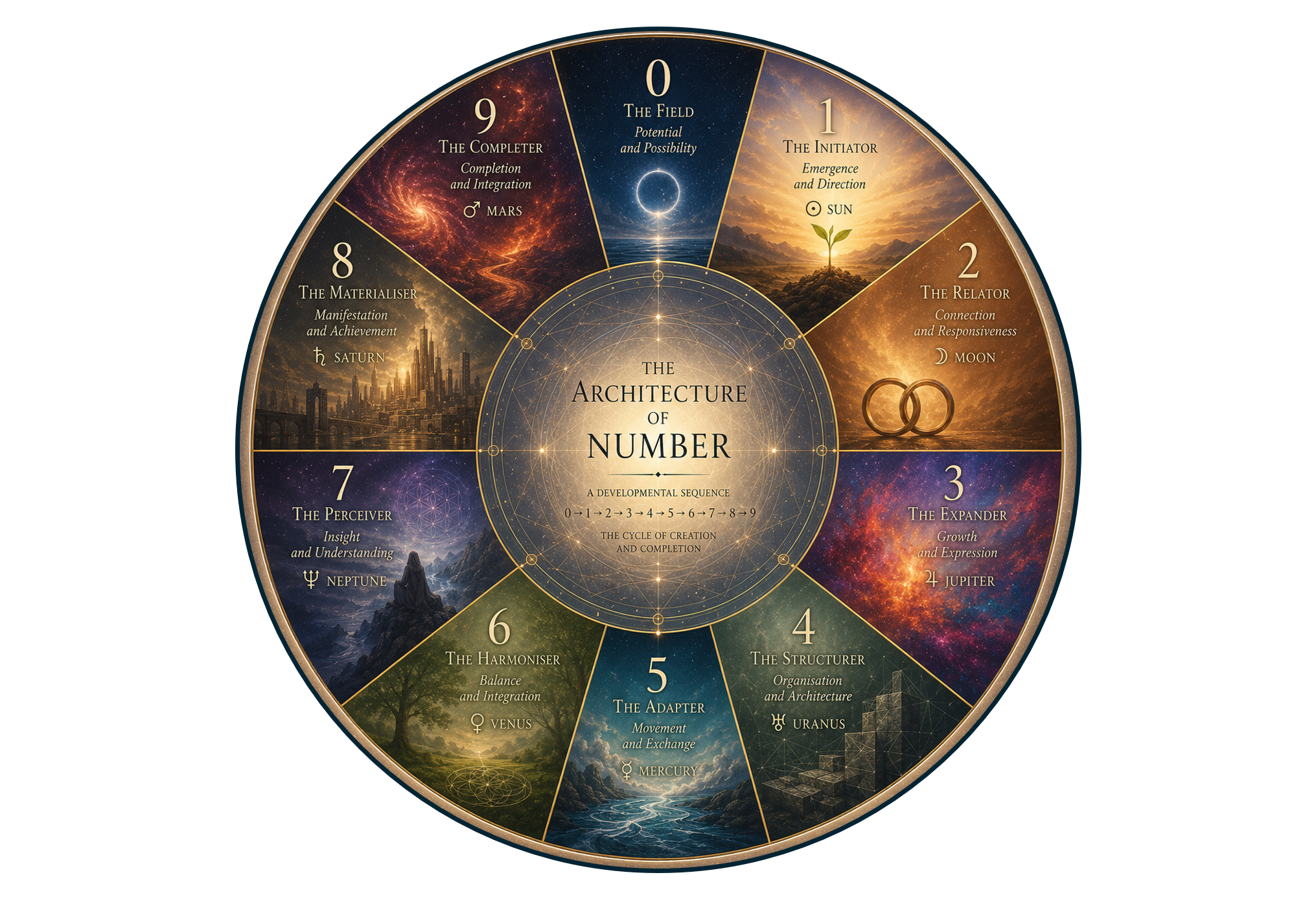
Cosmic wheel of numbers and symbols by Astrrid and AI
1st August 2026
Most people encounter numerology through individual numbers. They learn that 1 represents leadership, 2 represents partnership, 3 represents creativity, and so on. While these descriptions are useful, they can sometimes obscure something even more fundamental.
The numbers do not simply exist as separate symbolic principles. They form a sequence.
Viewed in this way, the numbers 0–9 can be understood as a developmental process through which reality unfolds. Each number emerges from the one before it, responds to the conditions created by the previous stage, and introduces a new principle that allows the cycle to continue. Rather than ten isolated meanings, we find a single movement progressing through different phases of development.
This perspective helps explain why numerical patterns appear so consistently throughout life. The numbers can be observed within people, relationships, businesses, organisations, creative projects, and personal growth. They are not merely descriptions of personality. They are descriptions of process itself.
To understand this in Chaldean Numerology, let us begin where every cycle begins.
0 — THE FIELD
Before there can be movement, there must be a space within which movement can occur. Before there can be identity, there must be potential. Before there can be one, there must be zero.
I explored the symbolism of 0 in greater depth in a previous article, but for our purposes here, 0 can be understood as the underlying field from which all possibility emerges. It is not a manifested principle in the same way as the numbers that follow. Rather than acting, it contains the potential for action. Rather than expressing itself directly, it provides the space within which expression becomes possible. It is the underlying generative field from which all numerical structure, potential, and interaction emerge.
1 — THE INITIATOR
Where 0 is the field, 1 emerges into identity.
1 is the Initiating Principle: the force of emergence, identity, and first movement. It is the moment possibility becomes direction, when something distinguishes itself from everything else and begins its own journey. Every cycle starts here, with a decision, an impulse, or a first step that transforms potential into action. At its highest expression, 1 leads through clarity, confidence, and purposeful action; in distortion, it becomes isolated, domineering, or over-identified with self-will.
2 — THE RELATOR
Where 1 defines itself, 2 recognises the other and responds.
2 is the Relational Principle: the force of connection, response, and mutual awareness. Once identity exists, relationship becomes possible. The individual encounters the wider world, learning that growth rarely happens in isolation. Through cooperation, reflection, and exchange, 2 develops sensitivity to the needs of both self and others. At its highest expression, it harmonises and attunes; in distortion, it loses itself through over-adaptation or emotional dependency.
3 — THE EXPANDER
Where 2 connects, 3 expands into growth and expression.
3 is the Expansive Principle: the force of growth, expression, and amplification. Relationship naturally creates new ideas, opportunities, and possibilities. What was once contained begins extending into a wider world through creativity, communication, and exploration. At its highest expression, 3 inspires optimism, imagination, and joyful expansion; in distortion, it becomes excessive, scattered, or directionless.
4 — THE STRUCTURER
Where 3 expands, 4 differentiates, organises, and creates form.
4 is the Structuring Principle: the force of organisation, pattern, and architecture. Expansion creates increasing complexity, and complexity requires organisation. Rather than simply preserving what already exists, 4 defines, arranges, and restructures the elements of a system into coherent frameworks capable of supporting further development. At its highest expression, it brings clarity, functional design, and intelligent organisation; in distortion, it becomes rigid, restrictive, overly controlling, or attached to structures that no longer serve their purpose.
5 — THE ADAPTER
Where 4 establishes form, 5 introduces movement, exchange, and adaptation.
5 is the Adaptive Principle: the force of change, movement, and recalibration. No structure remains effective forever. As circumstances evolve, flexibility becomes essential. The role of 5 is to keep systems alive through curiosity, communication, experimentation, and responsiveness to change. At its highest expression, it brings adaptability and versatility; in distortion, it becomes unstable, scattered, or directionless.
6 — THE HARMONISER
Where 5 explores variation, 6 seeks coherence, harmony, and integration.
6 is the Harmonising Principle: the force of balance, cohesion, and integration. Having explored many possibilities, the cycle now seeks to bring them into meaningful relationship. Rather than imposing order, 6 creates coherence through attraction, cooperation, and shared purpose. At its highest expression, it integrates and harmonises; in distortion, it becomes controlling, over-responsible, or self-sacrificing.
7 — THE PERCEIVER
Where 6 creates coherence, 7 perceives the deeper pattern and meaning.
7 is the Perceptive Principle: the force of insight, awareness, and depth. Once harmony has been established, attention naturally turns towards understanding. Rather than simply observing appearances, 7 seeks the principles, patterns, and meanings operating beneath them. It asks not only what is happening, but why. At its highest expression, it brings clarity, insight, and deeper perception; in distortion, it becomes disconnected, confused, or withdrawn.
8 — THE MATERIALISER
Where 7 perceives the pattern, 8 gives it tangible and enduring form.
8 is the Materialising Principle: the force of manifestation, execution, and tangible outcome. Insight now seeks expression within the material world. Ideas become enterprises, visions become achievements, and principles become practical realities through sustained effort and responsible stewardship. At its highest expression, it delivers results with integrity, competence, and endurance; in distortion, it becomes restrictive, controlling, or overly burdened by material concerns.
9 — THE COMPLETER
Where 8 establishes reality, 9 acts to complete, release, and renew the cycle.
9 is the Completion and Integration Principle: the force of closure, resolution, and integration. Every cycle eventually reaches a point where action is no longer directed towards building, but towards completing. The role of 9 is to bring the journey to a meaningful conclusion, integrating what has been learned before creating the conditions for renewal. At its highest expression, it completes and releases with courage, clarity, and purpose; in distortion, it resists necessary endings, leaving cycles unresolved or prolonging what has already fulfilled its purpose.
Completion creates the conditions for renewal, allowing the cycle to return once more to potential.
Seeing the Cycle in Action
Theory becomes easier to understand when we observe it in the real world. The developmental sequence described by the numbers can be found almost everywhere. We can see it within relationships, creative projects, organisations, personal development, and the growth of a business.
Consider the journey of an idea becoming a successful business:
0 provides the Field. A possibility exists, but nothing has yet taken form. There may be inspiration, intuition, or recognition of an opportunity, but the business itself remains unmanifest.
1 initiates. Someone decides to act. A direction is chosen, ownership is taken, and the first steps are made toward turning the idea into reality.
2 relates. The founder begins engaging with customers, suppliers, advisers, partners, and the wider marketplace. The idea encounters the world beyond itself.
3 expands. The concept grows. New ideas emerge, conversations increase, opportunities appear, and the vision begins reaching a wider audience.
4 structures. Expansion gives way to architecture. The business begins organising its people, resources, systems, and activities into a coherent framework capable of supporting its continued development.
5 adapts. The business responds to changing markets, customer feedback, competition, and new opportunities. Flexibility becomes essential.
6 harmonises. Attention shifts towards culture, relationships, customer experience, and creating greater alignment between different parts of the organisation.
7 perceives. The business reflects on its purpose, performance, and direction. Analysis, insight, and strategic understanding become increasingly important.
8 materialises. The vision produces tangible results. Revenue, assets, reputation, influence, and measurable outcomes begin reflecting the work that has preceded them.
9 completes. A chapter reaches completion. A product line ends, a founder moves on, or the organisation prepares for its next phase of development. Lessons are integrated, the cycle is completed, and the ground is prepared for a new beginning.
The Cycle Continues
Seen in isolation, the numbers appear to describe separate archetypes. Viewed as a sequence, they reveal something deeper: a developmental process through which potential becomes reality.
0 provides the field → 1 Initiate → 2 Relate → 3 Expand → 4 Structure → 5 Adapt → 6 Harmonise → 7 Perceive → 8 Materialise → 9 Complete
And from completion, the cycle returns once more to potential.
This is why the numbers appear in so many areas of life. They do not simply describe people. They describe developmental processes that can be observed throughout reality itself.
Numerology, at its deepest level, is not merely the study of numbers. It is the study of how potential becomes form, how form develops through experience, and how every completed cycle creates the conditions for a new beginning.
~ Astrrid
Continuing the Conversation...
The numbers 0–9 form the foundation upon which every larger numerical expression is built. Understanding their underlying principles provides a framework for understanding not only compound numbers, but the broader architecture of numerology itself.
This developmental sequence also forms the foundation of the Astrrid Numerology System. Rather than treating numbers as isolated symbolic meanings, the system understands them as interconnected principles that describe how potential differentiates, develops, and expresses itself through successive stages. Whether exploring compound numbers, personal charts, names, timing cycles, or business numerology, the same underlying architecture continues to operate. Complexity increases, but the principles remain the same.
Future articles will continue exploring how this architecture unfolds through compound numbers, naming systems, life paths, and the many ways number symbolism can be applied to everyday life.
Further Reading
Bringing the Numbers to Life
Understanding the architecture of numbers is one thing. Understanding how these principles are expressing themselves within your own life, relationships, name, business, and current cycle is something else entirely.
My work combines traditional Chaldean numerology with astrology to help individuals, founders, professionals, and organisations gain greater clarity around identity, timing, decision-making, and meaningful change.
If you would like to explore how these patterns are operating within your own experience, you can learn more about my consultations, naming services, and business offerings below.