
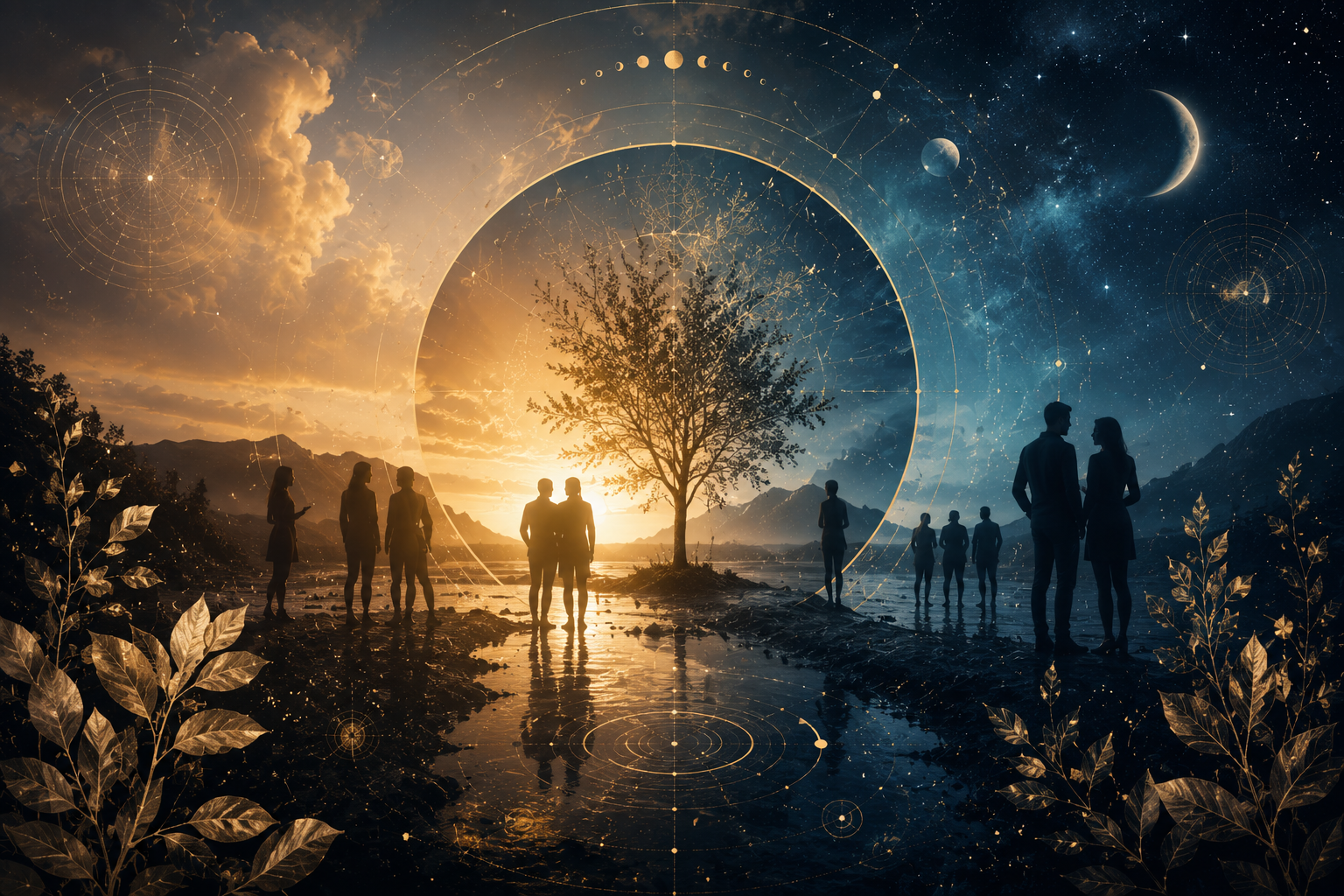
Celestial horizon with cosmic alignment by Astrrid and AI
25th May 2026
Recently, I have been reflecting on relationships and the strange way people move through our lives.
Some remain present for decades. Others appear intensely for a short period and then quietly disappear again. Some relationships feel foundational and enduring. Others seem catalytic and arrive at precisely the right moment to alter our direction before naturally fading back into distance.
The same appears true not only for individuals, but for groups as well. Friendship circles, communities, workplaces, spiritual environments, creative collaborations, and social ecosystems all seem to possess their own developmental patterns. Some remain vibrant and adaptive across many years. Others gradually lose vitality while continuing largely through habit, history, or structural momentum.
It has made me question whether time alone really measures commitment, depth, or meaning.
We often assume that longevity automatically proves the value of a relationship. Yet I am not convinced this is always true. Some long-term connections continue because they are actively renewed through mutual participation, honesty, adaptation, and shared evolution. Others continue more through inertia. History carries them forward even after much of the original energy has faded. This is not necessarily a criticism, as inertia itself serves an important function. Stable relationships provide continuity, memory, grounding, and identity across time. They become part of the architecture of a life. In a world increasingly focused on reinvention, movement, and perpetual transformation, there is something deeply stabilising about people who remain present across long stretches of our existence.
Yet continuity alone does not always equal aliveness.
Two people may sincerely care for one another while the relationship gradually becomes more archival than developmental — sustained more by shared history than by present vitality. The same dynamic can exist within groups. Sometimes communities continue long after their original purpose, energy, or developmental function has shifted. People remain because identity formed there, belonging formed there, or because the structure itself became psychologically stabilising. We are not only attached to people. We also become attached to continuity.
What I find particularly interesting is how differently people seem to experience relationships by nature.
Some individuals appear highly cyclical and change-oriented. Others seek continuity, rootedness, and long-term emotional stability. Some thrive through broad social movement and constant new experiences. Others operate through a very small number of profound bonds maintained over decades.
Astrology and numerology both suggest that these differences may not be entirely random.
Within astrology, certain chart structures naturally orient people toward stability and endurance, while others emphasise exploration, reinvention, freedom, or periodic withdrawal. Numerology carries similar themes. Some numbers appear highly relational and continuity-focused, while others seek movement, change, autonomy, or cyclical transformation. From this perspective, people are not entering relationships from identical psychological architectures.
Equally interesting is the idea that relationships themselves develop their own identity over time. In astrology, for example, a composite relationship chart symbolically maps the relationship as its own entity — with its own strengths, tensions, purpose, and developmental trajectory. The relationship becomes more than simply the sum of two individuals.
The same principle can arguably be observed within groups, organisations, and communities. Over time, collective structures begin to develop their own energetic climate, behavioural patterns, and evolutionary pressures. Some groups feel alive and generative. Others feel stable but stagnant. Some exist primarily through active participation and renewal. Others continue more as historical containers preserving an earlier phase of identity.
This becomes even more noticeable when viewed through cycles of time. Different periods of life appear to draw us toward different people, experiences, and environments. During certain cycles, individuals may seek expansion, experimentation, reinvention, freedom, or entirely new forms of identity. During others, the focus shifts toward consolidation, family, healing, rootedness, or long-term stability.
Major astrological and numerological cycles often seem to coincide with these relational reorganisations. People enter new communities. Old friendships dissolve. Long-standing dynamics change form. Entire social ecosystems rearrange themselves around shifting internal needs and external conditions. Sometimes this occurs quietly at the level of the individual. At other times, larger collective cycles seem to affect entire groups simultaneously.
Periods of social instability, technological transformation, ideological change, or collective uncertainty often reshape relationships at scale. People reassess identity, belonging, values, and direction. Communities fragment and reform. New forms of connection emerge while older structures lose coherence.
Not all relational change is personal. Sometimes the wider cycle itself is changing the environment around us.
Perhaps this is one reason relationships can feel simultaneously meaningful and impermanent. We are not static beings forming static bonds. We are developmental systems moving through time, and relationships are not solely expressions of our own evolution. Instead they can be viewed as intersections between multiple evolving trajectories.
Sometimes another person changes direction. Sometimes their needs evolve differently to our own. Sometimes one person requires rootedness while the other requires expansion. Sometimes timing itself alters compatibility. This can be painful because humans naturally seek stable narratives around attachment. We want to believe that meaningful relationships should remain unchanged indefinitely.
Yet life rarely behaves so cleanly. People, groups, identities, and needs evolve. Some relationships renew themselves repeatedly and remain alive across many years. Others gradually transition from active participation into historical presence. Some dissolve entirely. Others fluctuate through cycles of distance and reconnection.
Increasingly, I suspect that a fulfilling life may require both continuity and vitality, roots and renewal, stability and emergence. Too much attachment to continuity can become stagnation. Yet a life composed only of transient intensity may eventually lack grounding, memory, and coherence.
Perhaps the deeper question is not simply, “How long did something last?” But instead is, “What role did it serve within the evolution of a life?”.
Some relationships teach.
Some stabilise.
Some awaken.
Some challenge.
Some witness.
Some archive who we once were.
And some help call forward who we are becoming.
All may matter, even if they do not all remain forever.
~ Astrrid
Continuing the Conversation...
Relationships do not exist outside time. They evolve through phases of growth, challenge, separation, reunion, commitment, and transformation. The people who enter our lives often do so at particular moments for reasons that only become clear with hindsight.
Whether viewed through astrology, numerology, or simple life experience, timing frequently plays a larger role in relationships than we initially realise. Sometimes the question is not whether a relationship is possible, but whether it is ready.
If you would like to explore your own cycles of growth, timing, relationships, and life direction through astrology, numerology, and symbolic analysis, you can find more information about working with me here.
Or join The Astrrid Journal below to stay connected and be notified of future articles.
Further Reading