
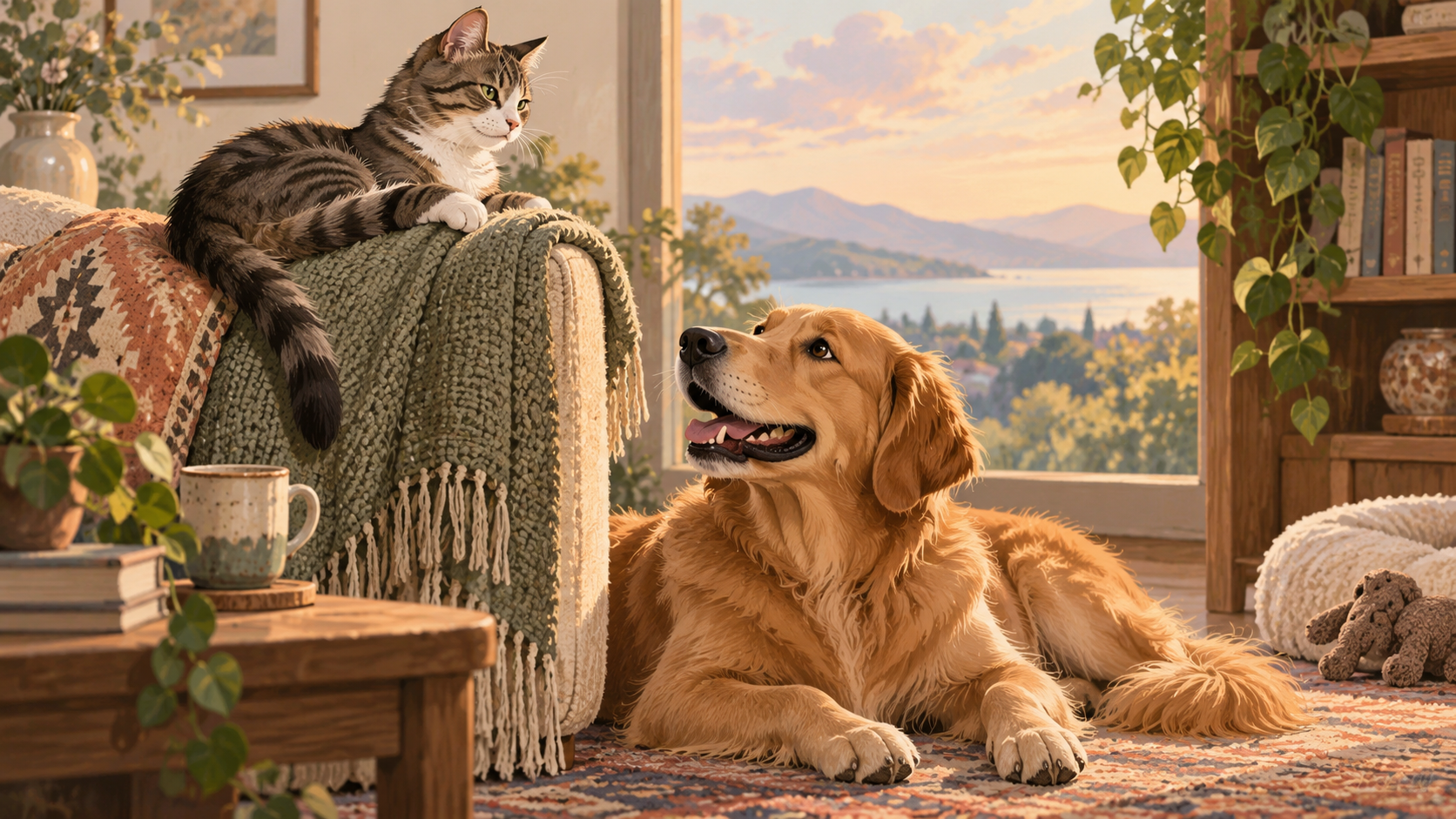
Golden Hour Companions by the Window by Astrrid and AI
8th September 2026
It started with me wandering off at a conference…
I had gone to a conference in London for three days, and although I thoroughly enjoyed being there with friends and taking part in conversations, I kept finding myself slipping away from the group for periods of time. I would wander around on my own, go and look at something, sit somewhere quietly, or simply remove myself from the collective activity for a while. There was nothing wrong. I wasn't upset, overwhelmed, or having a bad time. I simply didn't want to be around everybody continuously. During one of these ‘break out sessions’, I remembered that I used to do exactly the same thing back in my younger days of clubbing with friends. I’d say I was going for a wander, and then do just that – disappear for a while, explore the venue by myself, dance alone at the back so I could take in the room, perhaps talk to someone elsewhere (though often not), and eventually reappear. My friends simply became accustomed to the fact that I occasionally wandered off.
And then it occurred to me - I was behaving like a cat.
Not in the sense that I dislike people. Quite the opposite. I can be extremely affectionate, loving and deeply attached to people. I’m happy being stroked - although occasionally might scratch..! Things are very much on my own terms. I like my own space, and need periods of solitude. I enjoy company enormously and then, quite suddenly, may feel perfectly content to wander off and do something by myself. I don’t particularly understand the assumption that closeness must involve doing everything together. Not anymore. It’s not that I’m looking for alternative or better company - more that I just don’t want any company at that particular time. The more I thought about it, the more the metaphor amused me. I am very definitely a cat.
Of course, this is not intended as a serious personality classification system. There is no validated Cat-Dog Relational Typology lurking somewhere in the psychological literature - at least not that I am aware of. But simple metaphors can sometimes reveal something that more elaborate descriptions obscure, and I began wondering whether people might broadly differ in the way they approach connection in ways that feel surprisingly cat-like or dog-like. The distinction is not really about whether someone is introverted or extroverted, although there may be some overlap. It is more about how we regulate closeness, autonomy, belonging, affection, and the ongoing maintenance of relationships.
A dog-type person seems naturally oriented towards the pack. They tend to enjoy connection, shared activity, regular contact, and a sense of belonging to something larger than themselves. They notice who is coming, who hasn't turned up, who needs including, and when everybody should get together again. At their healthiest, dogs can be wonderfully loyal, generous and relationally invested. They help create continuity between people. They keep friendships alive, organise gatherings, check in, invite you along and generally make sure the social ecosystem continues to function. Most of all, they seem to possess an instinctive understanding that relationships need feeding.
Cats bring something different. A cat may love you enormously, follow you around the house, yet still want you to leave them alone for a while. They may form very deep bonds while retaining a strong sense of their own territory, rhythm and independence. Unless they’re one of the more nasty types that attack just for the fun of it (!), they can be intensely affectionate without wanting continuous interaction, and highly loyal without needing to demonstrate that loyalty through constant contact. A cat may disappear into their own world for a period and then return expecting the relationship to be exactly where they left it. They are often comfortable with silence, separateness and parallel activity. At their healthiest, cats bring independence, interiority, discernment. and the ability to remain themselves even when they are closely bonded to another person.
There is no hierarchy here. Cats are not better than dogs, or vice-versa. The world needs both species. Dogs are not more loving because they are more demonstrative or socially engaged, and cats are not more sophisticated because they are more independent. Both bring something valuable to relationships, and both can become distorted when their natural tendencies become excessive or damaged. A wounded dog may become approval-seeking, anxious, over-accommodating, or unable to tolerate distance. Or savage and want to bite you. Or perhaps becomes the very saddest type of dog who has been repeatedly kicked and shies away from everyone. A wounded cat may become avoidant, inaccessible, excessively self-sufficient, or so feral and accustomed to independence that ordinary relational needs begin to feel intrusive. Or literally keep attacking anyone that tries to get close. What matters is not whether someone is naturally more cat-like or dog-like, but what has happened to those instincts through experience. The same qualities that make a dog warm, loyal, and relational can become anxious, submissive or aggressive when trust has been damaged - just as a cat’s independence and self-possession can harden into withdrawal, defensiveness or hostility. The distinction is therefore less about closeness versus distance than about the different ways each type learns to give, receive and protect connection.
I know something about the less balanced version of catness because I have gone through what I now jokingly think of as my feral period. Mine did not begin simply because I enjoyed my own company. I had been badly knocked by life, was very physically unwell, disappointed and depressed, and withdrew into a much less healthy form of catness. Solitude became less about restoration and more about retreat, and over time I became increasingly disconnected from ordinary social life. As I recovered, that withdrawal gradually changed character. I became even more self-sufficient than before, and extraordinarily accustomed to organising life around my own rhythms - to the point where independence no longer felt like something I had chosen so much as the natural structure of my life. There are real strengths in that, but it also meant I had become out of practice at some of the ordinary give-and-take of relationship - accommodating other people's rhythms, making space for regular contact, allowing plans to interrupt my own preferences, and participating consistently in a wider social world. Over recent years, I have therefore been slowly re-socialising — not trying to turn myself into a dog, but learning how to be a healthy, relational non-feral cat again.
This may be one reason I have always loved to have dogs in my life.
One of my close male friends is unmistakably dog-like. He is relational, loyal, socially oriented, and much more naturally invested in the wider pack than I am. He has been crucial in my journey towards re-socialising and re-learning relationships. His beloved but sadly deceased partner was also very much a dog, and I suspect that suited him in a way that is different from what he gets from his friendships. He seems to benefit from having some close female cat friends around him, myself included, perhaps because we bring a different quality into his relational ecosystem. At the same time, I can see why another dog may suit him better in partnership, because that kind of person is more likely to share his natural investment in togetherness, regular contact, and the ongoing maintenance of a shared life. The cats around him may help balance him, while another dog may be better placed to meet him at the level of partnership. In return, his dog qualities are utterly invaluable to me. Dogs can draw cats back into the world, maintain contact, and keep relational bridges open when the cat might otherwise wander off into the undergrowth for six months and assume everyone will still be there when they return. I genuinely do need and really appreciate the close-relationship dogs I am blessed to have in my life.
This led me to another realisation. My previous long-term partners have been dogs (no pun intended!).
At first I thought this might suggest that I simply need dog energy in partnership, and perhaps I do. I am certainly attracted to people who are naturally warm, socially engaged, and relationally generous, and they in turn have often seemed very attracted to my inner cat. But looking back, I can also see where I made a mistake. Once fully immersed in a relationship, I began trying to shapeshift into a dog. I gradually placed parts of my cat nature to one side. I became more oriented towards the couple, totally absorbed in accommodating of shared rhythms and less protective of my own solitude and independence. None of this necessarily looked dramatic from the outside, but internally something important was being lost.
The problem, I now think, was not that I had dated dogs. The problem was that somewhere along the way I had absorbed the idea that being in a relationship meant I should become one. And that probably wasn’t ideal for my partners either, because they hadn’t chosen another dog in the first place. They had been attracted to the cat.
So there is an important distinction between intimacy and fusion. A cat may need considerable closeness, affection and emotional depth while still requiring plenty of private space. In fact, removing that autonomy may eventually make the cat less affectionate rather than more. The cat who knows the door is open may happily remain in the room. The cat who feels the door has been locked may go slightly crazy as it starts looking for a window. For someone whose natural relational orientation includes a strong need for independence, maintaining a sense of choice may actually make deeper intimacy possible.
This is where the cat-and-dog metaphor becomes more interesting than simply suggesting that opposites attract. Not every cat should date a dog, and not every dog will be happy with a cat. Some dogs may need a partner who shares their enthusiasm for togetherness, regular communication, and a highly integrated life. A dog who constantly feels as though they are waiting for their cat partner to return may eventually become lonely or insecure. Equally, some cats may find another cat's independence enormously comfortable because neither person interprets space as rejection. Two cats may happily maintain separate interests, separate friendships, and substantial periods of solitude while remaining deeply bonded.
But two cats have their own potential problem - they may keep missing each other.
Neither wants to intrude. Neither particularly needs constant reassurance. Both assume the bond is intact. Each is perfectly capable of entertaining themselves, and suddenly they realise that nobody has actually suggested seeing one another for several days. A cat-and-cat relationship may therefore require more deliberate relational maintenance than a cat-and-dog pairing, because neither person is naturally providing as much momentum. Yet this could also be very healthy. Instead of relying on the dog partner to maintain the relational field, both cats learn to choose connection consciously.
Perhaps the important question is therefore not whether a cat should date a dog or another cat, but what the wider relational ecosystem looks like.
A cat with plenty of dogs in their life may be a very different proposition from a completely feral cat. They may have friends who draw them into gatherings, colleagues who keep them connected, family members who maintain regular contact, and communities in which participation is expected. Through those relationships they may have developed skills to exist within the pack without ceasing to be fundamentally cat-like. They know how to initiate, include, check in, make plans and sustain relationships, but they do not require continuous contact in order to feel secure. Two cats like this could potentially create a very spacious but deeply connected partnership.
Likewise, a dog may benefit enormously from cats in their wider life even if they are happier partnering another dog. Cat friends can introduce different rhythms into the pack. They may challenge assumptions about constant availability, model stronger boundaries, or simply provide relationships that do not require quite so much maintenance. The partner does not have to supply every balancing quality we need. Sometimes the health of a relationship depends partly on whether each person has a sufficiently varied ecosystem around them.
This is one reason I have become wary of the idea that compatibility means finding someone exactly like ourselves. Sometimes similarity creates ease. Sometimes difference creates balance. What matters is whether those differences allow each person to remain recognisably themselves. A secure dog does not need to chase the cat every time it wanders away, and a secure cat does not need to interpret every invitation as an attempt to restrict its freedom. The dog can say, "Come with us," and the cat can decide whether it wants to. The cat can disappear for a while, and the dog can trust that it will return.
Perhaps this is also where the healthier versions of both archetypes begin to emerge. A mature cat learns that independence does not require isolation, and that loving people sometimes means making the effort to return, initiate and participate. A mature dog learns that closeness does not require constant access, and that another person's independence is not necessarily evidence of rejection. Neither needs to become the other. They simply develop enough range to relate across the difference.
For me, that may be the more useful lesson emerging from what started as a slightly ridiculous observation about wandering off at a conference. I do not need to become less cat-like in order to have richer relationships. If anything, I probably need to become a better-socialised cat - still independent, still fond of wandering, still perfectly capable of enjoying my own company, but less inclined to disappear completely into the undergrowth. And if I eventually choose another dog as a partner, perhaps the task is not to shapeshift into his species this time. It is to remain a cat who is very happy to share a life with a dog.
Then again, perhaps I could date another cat. If he has enough dogs in his life, and I have enough dogs in mine, we might simply need to remember to come home occasionally.
So perhaps the question is not really whether you are a cat person or a dog person.
Perhaps it is: are you a cat or a dog yourself, what do you bring to the people around you, and are you living as the healthiest version of your own species?
~ Astrrid
Continuing the Conversation…
So, are you a cat or a dog?
You may recognise yourself immediately, or perhaps you are somewhere in between. You might also notice that you behave differently in friendship, family life and romantic relationships, or that life experience has pushed you towards a more wounded version of your natural style at certain times.
It may also be worth considering the wider ecosystem around you. Do you have enough people who naturally draw you into connection, or enough people who respect your need for space? Do your closest relationships allow you to remain yourself, or have you ever found yourself shapeshifting into another species in order to make a relationship work?
And perhaps the most useful question of all is not simply whether you are a cat or a dog, but whether you are currently living as a healthy version of whichever one you happen to be.
My work often explores these kinds of patterns through astrology, numerology, and symbolic intelligence - the ways we are naturally wired, the roles we fall into, the adaptations we make, and what happens when we begin to live more consciously in alignment with our own nature rather than simply repeating familiar patterns.
If you enjoy these kinds of reflections, The Astrrid Journal is where I continue exploring identity, timing, relationships, symbolism, and the deeper patterns that shape how we live and relate.
Or you can find out more about the services I provide here.
Continue the Journey
When Everything Becomes Too Interesting: A Virgo Lesson in Discernment
This Symbolic Life - For more personal essays, reflections, and shorter explorations of the ideas behind my work, visit This Symbolic Life on Substack.